What the documents look like

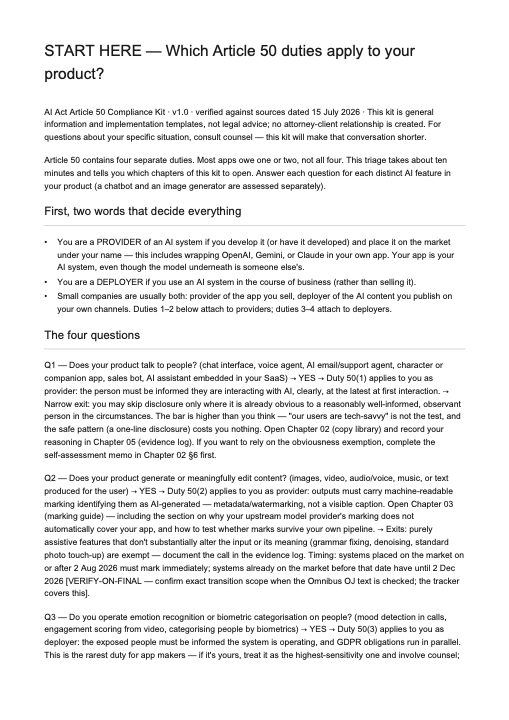
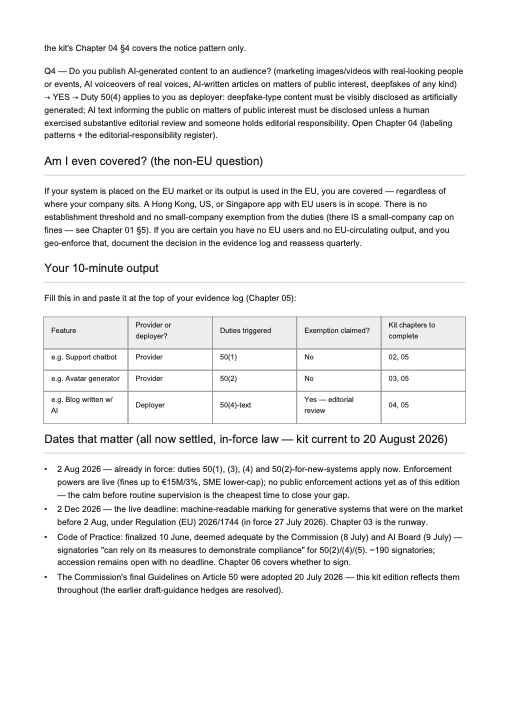
These are real pages, not mockups — open the free sample to read them.
The final Guidelines put the disclosure and marking duty on your application, not your model provider — and ordinary pipelines strip upstream marks in transit. This kit closes the gap in a working day.
Instant download · 14-day unconditional refund · English + 中文 editionsSecure checkout by Polar (merchant of record; card processing by Stripe) · VAT handled · instant download · edition 1.2, current to 20 August 2026. Question first? esau@trykilde.com — a person answers within one business day.
These are real pages, not mockups — open the free sample to read them.
PDF + editable filesEN + 中文Updated through the 2 Dec 2026 marking wave
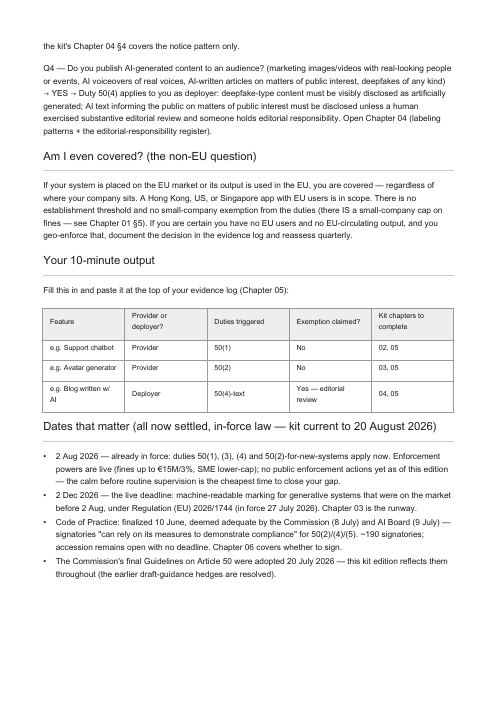
The first pages of the actual pack, edition 1.2, current to 20 August 2026. Open the free 4-page sample (PDF) — no email needed.
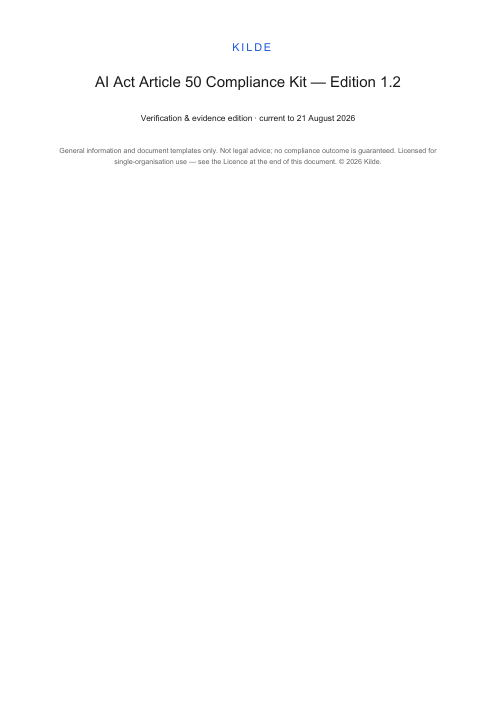
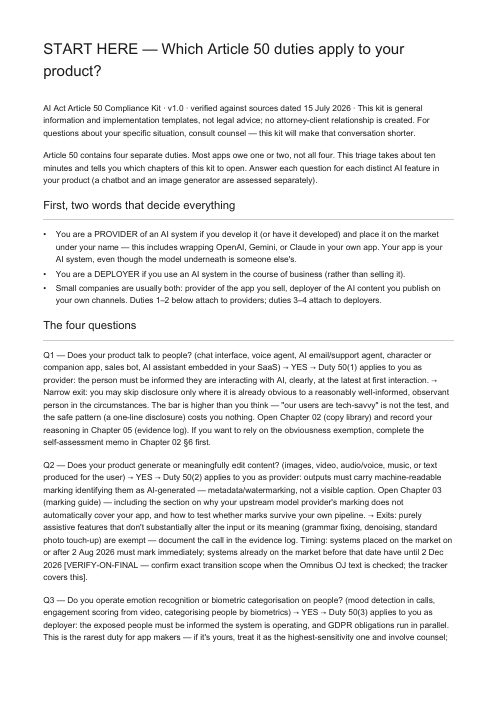
Rises toward $290 as the 2 December deadline approaches. Optional update tracker (+$49/mo): guideline changes, Code-of-Practice updates, the countdown. Kit current to August 2026 — final Guidelines, approved Code of Practice, and the Commission's official AI-label icons all reflected.
Get the kit — instant downloadNo. This is an implementation kit — organized information and ready-to-use artifacts built from the regulation, the Code of Practice, and the Commission's guidance, each with source citations. For legal questions about your specific situation, consult counsel; the kit will make that conversation shorter and cheaper.
No. The 2026 Digital Omnibus postponed the high-risk system obligations to 2027–2028. Article 50's transparency duties were not postponed: they apply from 2 August 2026, with a transition window only for the machine-readable marking of systems already on the market.
No — and 2026 made this trap sharper in both directions. OpenAI ships C2PA + SynthID on images and Google ships SynthID today; Anthropic announced text watermarking + C2PA in August but it isn't live yet. Relying on "my provider handles it" fails one way when marks get stripped in your pipeline — and the other way when they were never there. The final Guidelines settled that the application-layer provider owes the duty. The kit's upstream checklist confirms what your provider actually emits, the survival tests prove what reaches your users, and the evidence log records both.
Transparency-obligation breaches carry fines set by the Act's penalty regime (the kit states the exact tier with citations). The bigger near-term risk for small vendors is enterprise customers demanding proof of compliance in procurement — the evidence log answers both.
Free checklists tell you the law exists. This hands you the sentences, the metadata implementation steps, and the register — the parts that otherwise cost a week of your time or four figures of counsel time.
Kilde sells document templates and organised regulatory information. It is not a law firm and does not provide legal advice; buying a pack does not create an attorney-client relationship. Built and maintained by Kilde's founder, a practising attorney admitted to a US state bar (not an EU or Hong Kong admission). About Kilde · Verification log · Refunds · Terms · Privacy · esau@trykilde.com
This edition: v1.2 · current to 20 August 2026 · changelog · Article 50 guides. A copy obtained anywhere else receives no updates and goes stale from the day it was taken.
Disclaimer: This kit provides general information and implementation templates. It is not legal advice, and no attorney-client relationship is created. Regulations change; the kit cites its sources and dates every claim. © 2026 Kilde. 中文版